At different levels, businesses strive to deploy transparency, fair trade, sustainability in customer purchasing decisions. However, complex and non-integrated supply chain networks make it difficult to implement these principles.
A large number of organizations have started incorporating Blockchain in supply chain management to make all processes more transparent and better-organized. According to Statista, 55.3 percent of logistics service providers state that they invested money in Blockchain technology in that area.
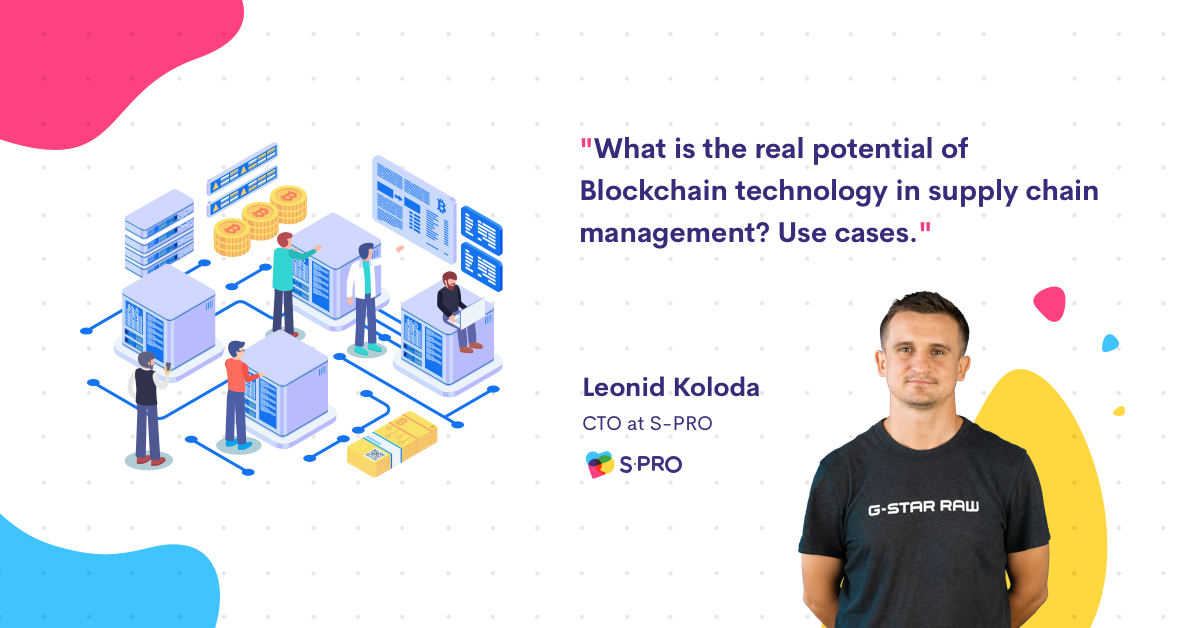
In this article, our experts will evaluate the real potential of Blockchain technology in supply chain management and consider use cases.
Today's Supply Chain Challenges
Lack of end-to-end visibility
The lack of transparency can cause cost and customer relationship issues, which can negatively influence a brand name. Blockchain technology offers a solution that the product provides provenance tracking. The system participants, including suppliers, manufacturers, couriers, and end-customers, are permitted to access this information, which helps to establish trust between them.
Inefficient supply chain risk management
The company's processes are usually exposed to different types of risks, such as fraud and code of conduct violations. Effective risk management programs are essential to effective supply chain management. Blockchain allows accurate product tracking, which helps predict many risks in the chain and lets all participants act appropriately.
Extra costs caused by fraud or product duplicacy
Blockchain allows real-time product tracking, which helps significantly reduce the overall cost of moving an item in a supply chain. By strengthening the traceability, in situations such as product recalls or quality issues, companies can isolate a problem accurately, minimizing cost spend trying to locate its root cause.
Blockchain Appliances in Supply Chain Management
Accurate tracking and traceability
Blockchain technology is often used to record product status at each phase of its lifecycle. It helps to track processes starting from the initial stage of production. For example, the world commercial giant Walmart actively utilizes this technology for monitoring sales of meat in China.
Writing smart contracts
A smart contract is a program that utilizes Blockchain to execute the agreement. You can integrate smart contracts into your supply chain management to prevent fraud or other interference. It is a software program that uses Blockchain to execute an agreement. The program is stored on the Blockchain so the smart contract can only function according to its programming.
Establishing trust
Establishing trust between all participants is key to the effective supply chain functioning. In a Blockchain, every participant has a copy of a ledger and knows where each item originated. Everybody has access to information about who has owned it before and when. A world-famous brand Nestle is a great instance of Blockchain in a food supply chain.
Blockchain Traction in The Supply Chain
Many companies face the challenge of extraordinarily complicated supply chain management that also weakens other internal processes. However, Blockchain technology has the potential to solve significant glitches in traceability and surveillance along the chain. It enhances efficiency across all operations of the flow of goods, information about the storage and shipping of raw materials, delivering finished products from one point to another, and more.
Contact Us https://bccs.tech/contact-us/ or view our services https://bccs.tech/services/
Share this post